


Rapport Is a Skill
7 April 2026
Beyond Good Intentions: The Mechanics of Rapport in Stakeholder Conversations
21 April 2026In our previous post, we explored Mendelow’s Matrix, a fundamental tool for mapping stakeholders along two dimensions: power and interest. By now, you know which stakeholders to manage closely, which to keep informed, which to keep satisfied, and which require minimal effort. That is already a significant step forward in your stakeholder engagement planning.
But here is a question worth sitting with: have you ever followed the matrix carefully, engaged all the right people at the right frequency, and still been blindsided by resistance late in the project?
If so, you are not alone. And the matrix is not to blame. There is simply one dimension it does not capture: stakeholders’ attitude towards the project.
What the Matrix Doesn’t Tell You
Power tells you how much influence a stakeholder can exercise. Interest tells you how much they care about the outcome. Neither tells you whether they are for or against what the project is trying to achieve.
A stakeholder in the “manage closely” quadrant (high power, high interest) can be your strongest champion or your most dangerous opponent. On the matrix, both look identical. The difference only becomes visible when you ask a separate question:
What is their attitude toward this initiative?
This is not a theoretical concern. Consider a project sponsor who has high power and high interest, but who quietly favours a competing initiative. Or a senior subject matter expert who is sceptical of the entire change program. Their position in the matrix tells you to engage them closely. Their attitude tells you HOW that engagement needs to work, and how much is at stake if you get it wrong.
The Third Dimension: Hillson and Simon’s Enrichment
In 2007, Hillson and Simon proposed exactly this enrichment. They added attitude as a third dimension to the power/interest grid, creating what they called the power/interest/attitude grid. Attitude, in their model, can range from negative to positive, and it operates independently of the other two axes.
What makes this addition particularly valuable for business analysts is a subtle but important insight: unlike power (largely determined by organizational hierarchy) and interest (often driven by factors outside your project), attitude can be influenced. It is not fixed. It can shift in either direction as the project evolves.
This means that identifying attitude is not just analytical work. It is the starting point for some of the most important relationship work a BA can do.
How to Assess Attitude
The simplest and most practical approach is to assess each stakeholder on a three-point scale:
- Positive: supportive of the initiative, willing to contribute and advocate
- Neutral: neither supportive nor resistant, often not yet fully informed or engaged
- Negative: sceptical or actively opposed to the change
You can layer this directly onto your existing Mendelow Matrix by adding a +, 0, or – sign next to each stakeholder’s position. Some teams use color coding instead. Either way, the visual result is immediately informative: you can see at a glance not just who matters most, but who among the people who matter most may be working against you.
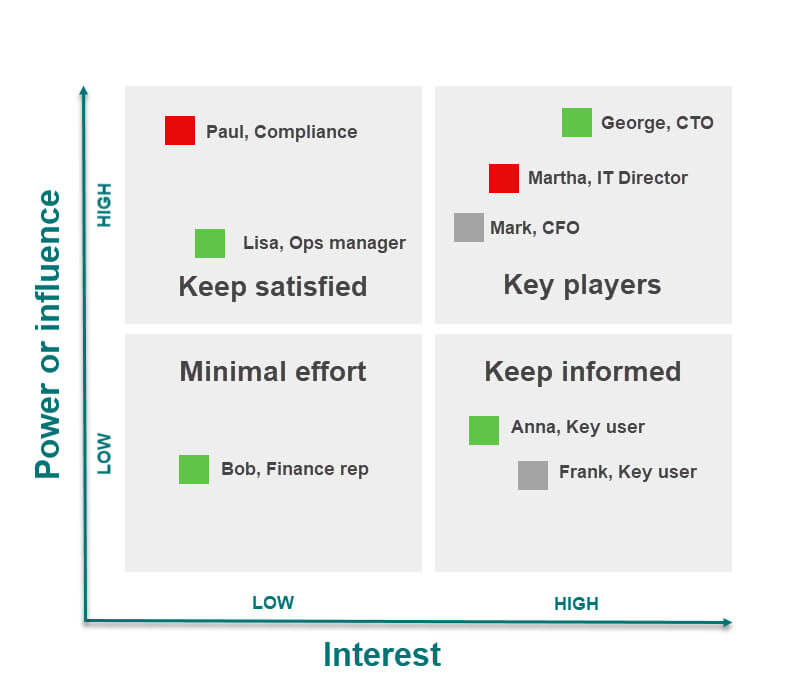
A few things to keep in mind when assessing attitude:
Negative attitude can appear in any quadrant
Do not assume that “keep informed” stakeholders are harmless because they have low power. A determined opponent with low power but high interest and a wide informal network can significantly undermine stakeholder buy-in. Equally, do not assume that “manage closely” stakeholders are allies simply because they are engaged. Their engagement may be precisely because they intend to steer the outcome in a direction that does not serve the initiative.
Attitude and behavior are related but distinct
A stakeholder can hold a negative attitude while outwardly appearing cooperative. Watch for signals beyond what is said in formal meetings, like delayed responses, passive participation, concerns raised informally to others rather than to you directly.
Attitude is not permanent
A stakeholder who is negative today may become neutral or even positive with the right engagement. Understanding the root cause of a negative attitude is the first step toward shifting it. Is it a misunderstanding of what the change entails? A perceived threat to their role or authority? A previous bad experience with a similar initiative? The intervention looks very different depending on the answer.
Connecting Attitude to Your Communication Plan
Once you have mapped attitude alongside power and interest, your communication plan becomes considerably more nuanced.
For stakeholders with a positive attitude, your goal is to maintain and leverage their support. High-power advocates can be enlisted to champion the initiative with other stakeholders, particularly those who are resistant. Do not take their support for granted; keep them informed and involved.
For stakeholders with a neutral attitude, your goal is typically to build awareness and relevance. These stakeholders often just need to understand what is in it for them and for the organization. Clear, targeted communication that addresses their specific context usually moves them toward positive.
For stakeholders with a negative attitude, the approach requires more care. Communication alone is rarely sufficient. What is needed is genuine engagement, like listening to their concerns, acknowledging their perspective, and, where possible, involving them in shaping the solution. This is where rapport-building skills become essential. You cannot argue a stakeholder out of a negative attitude. But you can, over time, shift it through consistent, credible, and respectful engagement.
One important caution: not every negative attitude can be resolved, and not every sceptic can be converted into an advocate. Some opposition is rooted in genuine conflicts of interest that go beyond the project. In those cases, your goal is not conversion but risk management: understanding what a powerful, negative stakeholder might do, and planning accordingly.
Keep Your Map Current
Like the Mendelow Matrix itself, the attitude layer is not a one-time exercise. Attitudes shift as projects progress. Sometimes in response to your engagement efforts, sometimes in response to external developments you did not anticipate. A stakeholder who started as an enthusiastic supporter may become sceptical if early deliverables disappoint. Someone initially resistant may soften as they see the initiative taking shape.
Build regular reviews of your stakeholder attitude map into your project rhythm. Even a brief, informal check-in, simply asking yourself whether anything has changed in how key stakeholders are engaging, can surface early warning signs before they become late-stage surprises.
In Summary
Mendelow’s Matrix gives you a powerful foundation for stakeholder engagement planning. Adding the attitude dimension makes it a living, actionable tool for managing the human side of your initiative:
- Assess each stakeholder’s attitude as positive, neutral, or negative independently of their quadrant
- Layer this onto your existing matrix using simple +/0/– notation
- Use the combined picture to design engagement strategies that address not just who to communicate with and how often, but what each relationship actually needs
- Revisit regularly, because attitudes change
In our next post, we will continue exploring stakeholder analysis techniques. In the meantime, we are curious: has a stakeholder’s attitude ever surprised you — positively or negatively? Share your experience in the comments.
References
Hillson, D. & Simon, P. (2007). Practical Project Risk Management: The ATOM Methodology. Management Concepts.


